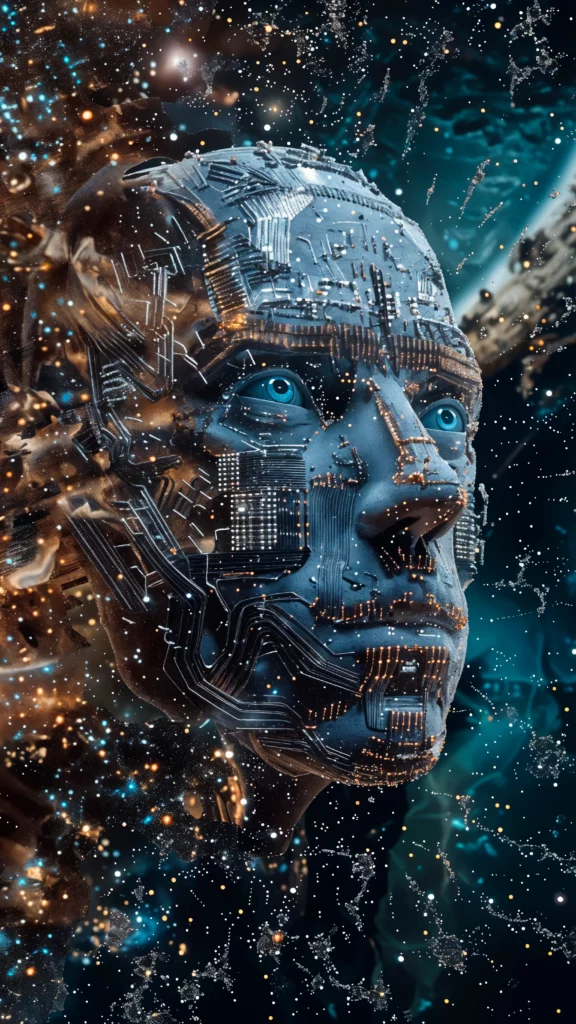
Generative artificial intelligence (Generative AI) is no longer a distant concept reserved for sci-fi stories or academic laboratories. Today, it stands at the center of a transformative digital revolution that is reshaping the very nature of human interaction with technology. We now live in an era where machines don’t just automate repetitive tasks — they assist, collaborate, and even create alongside us.
Text, images, audio, video, 3D environments, code, and even entire digital worlds can be produced in seconds with astonishing quality. This marks one of the most profound technological shifts since the rise of the internet and mobile computing.
Generative AI has enabled the emergence of creative machines capable of original composition, ideation, and execution. Imagine writing a complete marketing campaign in minutes, creating cinematic videos without a camera, or generating fully-functional code from a simple description. These are not hypothetical scenarios — they are daily realities for millions of users and professionals. For industries, creators, and companies worldwide, Generative AI is now the backbone of a new digital era.
The Qualitative Leap: Coherence, Context, and Multimodality
What makes the current wave of generative AI so revolutionary isn’t just the speed or volume of content these systems can create. The real breakthrough lies in coherence, contextual understanding, and multimodality.
Earlier AI models could produce text or images, but often lacked consistency or deeper understanding. Today’s systems — built on architectures such as Transformers and trained on immense datasets — interpret nuance, follow complex instructions, and maintain long-term coherence across extended reasoning tasks.
Multimodality represents another leap forward. While past models were restricted to a single type of input (usually text), the new generation of AI can seamlessly integrate:
- Text (generation, summarization, translation, reasoning)
- Images (editing, description, analysis, design creation)
- Audio (transcription, music composition, voice synthesis)
- Video (generation, scene analysis, content editing)
These capabilities allow users to work across multiple formats simultaneously, enabling a level of digital creativity previously unimaginable.
The Role of ChatGPT, Gemini, and Other Groundbreaking Tools
ChatGPT (OpenAI): The Evolution of Intelligent Dialogue
ChatGPT is widely recognized as the technology that made AI mainstream. Originally designed as a conversational interface, it has grown into a full digital assistant capable of research, writing, brainstorming, data analysis, and much more.
- Newer versions such as GPT-4 brought massive improvements in contextual accuracy, reasoning ability, and reduction of hallucinations.
- Features like plugins, GPTs, and the Code Interpreter transformed ChatGPT from a chatbot into a fully extensible tool.
- It can browse the web, analyze datasets, generate charts, convert files, write code, and execute complex calculations.
Because of its accessibility and versatility, ChatGPT became a foundational tool for businesses, educators, developers, and creators worldwide.
Gemini (Google): The Era of Native Multimodality
While ChatGPT expanded the boundaries of conversation, Gemini reimagined what it means to be a truly multimodal AI. Built by Google from the ground up as a single unified model, Gemini can natively understand and generate across text, images, audio, and video — without needing separate modules.
Its capabilities include:
- Analyzing a full meeting video and summarizing key takeaways
- Interpreting graphs, charts, and diagrams
- Assisting in complex, multi-step reasoning tasks
- Transforming visual information into structured insights
Because of its integration across Google Workspace, Android, YouTube, Search, and Cloud, Gemini is quickly becoming one of the most influential AI tools on the planet.
Other Generative AIs: Expanding the Creative Frontier
Across every medium, dedicated generative AI tools are emerging:
- Midjourney and DALL-E for high-fidelity image generation
- OpenAI’s Sora for realistic, dynamic video creation
- Runway for video editing and visual effects automation
- ElevenLabs, Soundraw, and AIVA for voice synthesis and music creation
- GitHub Copilot and Replit AI for improving software development productivity
Each tool pushes a different aspect of the creative frontier, making professional-grade content creation accessible to anyone.
Practical Uses: Transforming Reality Across Industries
Generative AI is not just impressive — it is profoundly useful. Its impact is visible across nearly every professional field:
Marketing and Content Creation
- Draft long-form articles, blog posts, email sequences, and captions
- Create full campaign concepts or refine messaging tone
- Generate SEO-optimized content and suggest keywords
- Produce ad images, landing pages, and video scripts within minutes
What used to take days can now be done in hours or even minutes.
Software Development
- AI tools can write code in multiple languages
- Suggest optimizations
- Identify bugs
- Document functions
- Speed up prototyping and debugging cycles
This dramatically accelerates development while reducing errors.
Education and Training
- Generate personalized study plans
- Create interactive exercises, quizzes, and simulations
- Summarize lectures, books, or research papers
- Translate complex concepts into simple explanations
Generative AI is democratizing access to high-quality learning resources.
Design, Architecture, and Visual Arts
- Produce rapid drafts for logos, websites, and UI layouts
- Explore alternative styles and visual directions instantly
- Create concept art, 3D assets, and mood boards
- Enhance photos and videos with AI-powered editing tools
Creatives can now iterate at unprecedented speed.
The Future and the Challenges of Generative AI
The next phase of generative AI is clear: greater accessibility, more personalization, and deeper integration into everyday workflows. We will soon live in a world where AI helps draft emails automatically, generates professional media on demand, and assists with everything from budgeting to business strategy.
However, this transformation comes with challenges:
- Ethical risks tied to bias and fairness
- Copyright disputes, especially around training datasets
- Deepfakes and misinformation, which are becoming more realistic
- Regulatory uncertainty, as governments attempt to create guardrails
The key to harnessing generative AI’s power responsibly lies in transparency, continuous oversight, and developing frameworks that encourage innovation while protecting society.
AI
When AI secures vs. when AI accelerates risk: The infrastructure paradox
Two months ago, I sat in a strategy meeting with a CISO and an autonomous vehicle engineer. The CISO was explaining how AI reduces false positives in cybersecurity—flagging only genuine threats, ignoring noise. The AV engineer was explaining how AI detects obstacles—being hypersensitive to avoid missing a pedestrian. Then someone asked: “So if we make […]
AI
AI Model collapse is happening now, not later: what your data filtering strategy should be
Three years ago, I spent six weeks analyzing a production language model at scale. The model was performing exactly as expected on benchmarks. On MMLU (a standard reasoning test), it achieved 86% accuracy. On proprietary internal datasets, the numbers looked even better: 92% on customer service queries, 89% on technical documentation classification. But there was […]
AI
Virtual reality vs AI for fashion E-commerce: the $50K decision that most brands get wrong
Learn how virtual reality and artificial intelligence diverge in purpose, interaction, and potential—discover the surprising differences that could shape your future decisions.
AI
Sora 2 vs runway Gen-3: when tool selection destroys (or saves) your production week
New dangers emerge as Sora 2’s AI blurs ethical lines—discover what makes this digital phenomenon so unsettling before it’s too late.
AI
The Dead Internet: 7 Proofs That 50% of the Web Is Now Bots
The Dead Internet Theory has officially transitioned from a fringe creepypasta to a measurable technical reality. It isn’t that humans have left the building; it’s that we’ve been out-produced by a synthetic tide. In 2024, nearly 50% of all internet traffic is non-human, marking the definitive arrival of the Dead Internet. This staggering statistic represents […]
AI Machine Learning Insights
How Machine Learning is transforming automation across industries
Uncover how machine learning is rewriting the rules of automation across industries—discover which sectors are changing fastest and what surprises lie ahead.