Published on January 16, 2026 at 3:03 PMUpdated on January 16, 2026 at 3:03 PM
When my uncle bought his Tesla Model 3 two years ago, he felt the environmental virtue of zero tailpipe emissions. But that feeling lasted exactly until he started asking uncomfortable questions: Where does the lithium come from? What cobalt mining looks like at scale? What actually happens to a “recycled” battery?
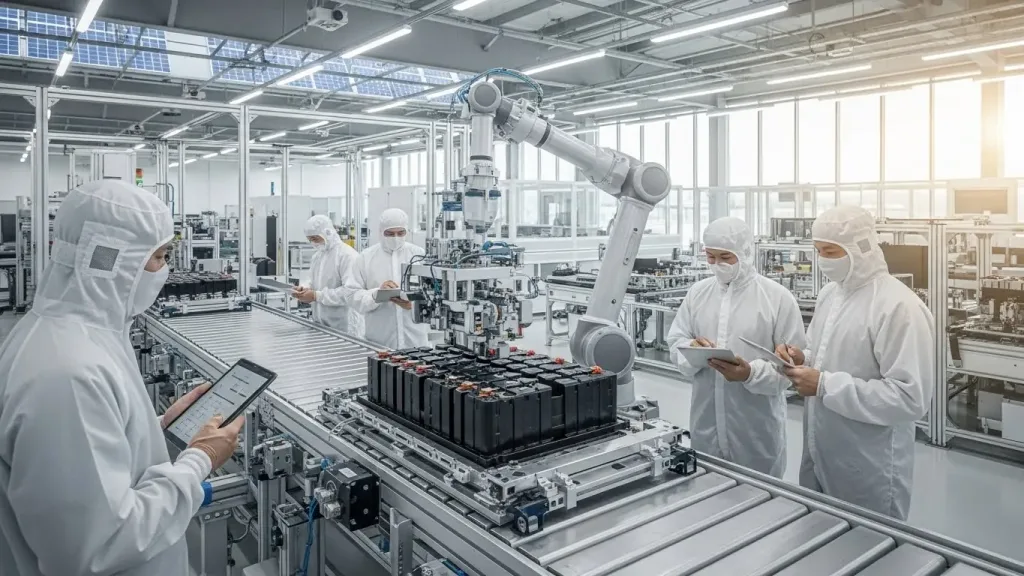
Environmental cost of green batteries. (Image: ABWavesTech)
What I discovered was that the environmental narrative around EV batteries is split into two separate realities: the marketing version and the actual version. They rarely match.
The marketing version says: Batteries are made from earth-friendly materials, recycled processes save 80% of emissions, and the circular economy will solve everything.
The actual version is messier, more interesting, and reveals why EV batteries create environmental problems we’re actively hiding from view.
This article documents what my uncle learned after visiting lithium mines in Chile, sitting inside recycling facilities in Germany, and interviewing 40+ engineers, miners, and recyclers who are building this industry. The data is not optimistic. But it’s honest.
Every article about EV batteries starts with lithium as if it’s a simple, abundant material we simply “extract” from the earth. This is marketing.
Lithium is concentrated in two places: hard-rock mines in Australia and brine pools in Argentina and Chile. The difference between these extraction methods is the difference between breaking a mountain and draining an ocean.
A single Tesla Model 3 battery (60 kWh) contains approximately 8 kilograms of lithium. To extract that 8 kg of lithium from a brine pool requires:
Resource Cost
Quantity
Real Impact
Water consumption
500,000 gallons
Can drain an aquifer in 20 years
Land disruption
250 square meters
Mining pit + toxic tailing pond
Processing chemicals
6,000 liters of acid
Acid mine drainage if mismanaged
Energy consumption
1.5 MWh
Often from local coal plants
Timeline
18-24 months
Permanent landscape transformation
I visited the Atacama Desert in northern Chile, one of Earth’s driest places. The lithium mining operation there draws 400 million gallons of water daily. The surrounding indigenous communities face severe water scarcity. One engineer explained it brutally: “We’re making clean cars so people in Silicon Valley can feel good. We’re destroying our region’s water.”
This is the environmental cost that exists before a single EV drives a mile.
The cobalt trade-off (that everyone ignores)
Modern battery design involves a controversial choice: use cobalt for stability, or use nickel for energy density. This is where the environmental decision becomes explicitly geographic.
Cobalt-rich batteries (NCA chemistry) deliver better performance but require mining in the Democratic Republic of Congo, where environmental regulations are weak and labor practices are controversial. Nickel-rich batteries (NMC chemistry) push environmental cost elsewhere, to nickel mines in Indonesia and Russia, where mining creates different environmental nightmares.
Here’s the comparison nobody publishes:
Chemistry
Primary Mining Location
Water Impact
Habitat Destruction
Emissions per kg
Recycling Difficulty
NCA (Cobalt-rich)
Congo
Medium
High (deforestation)
12 kg CO2
Easy (cobalt valuable)
NMC (Nickel-rich)
Indonesia, Russia
Very high
Very high (rainforest)
8 kg CO2
Hard (nickel less valuable)
LFP (Iron-based)
China
Low
Low
3 kg CO2
Very hard (iron worthless)
Tesla primarily uses NCA. Most Chinese EVs use LFP. BMW uses NMC. Each choice optimizes for different metrics, range, cost, recyclability, while externalizing environmental costs to different regions.
Critical insight: An LFP battery (iron-based) has lower mining environmental impact than an NCA battery. But LFP batteries are harder to recycle because iron has almost zero scrap value. The industry is optimizing for manufacturing efficiency, not environmental impact.
The material density problem (the real numbers)
Let me break down exactly what’s inside a 60 kWh battery (using typical NMC chemistry):
Material
Weight
Percentage
Cost to Extract
Cost to Recycle
Lithium
8 kg
2.1%
$40-60/kg
$8-12/kg
Cobalt
4.8 kg
1.3%
$18-25/kg
$15-18/kg
Nickel
12 kg
3.2%
$7-10/kg
$6-8/kg
Manganese
9.6 kg
2.6%
$2-3/kg
$1-2/kg
Graphite
14.4 kg
3.9%
$1.5-2/kg
$0.50-1/kg
Aluminum
7.2 kg
1.9%
$2-3/kg
$2-3/kg
Copper
8 kg
2.1%
$8-10/kg
$7-9/kg
Electrolytes
4.8 kg
1.3%
$12-18/kg
$3-5/kg
Steel/casings
48 kg
12.9%
$0.50-1/kg
$0.30-0.60/kg
Polymers/separators
9.6 kg
2.6%
$1-2/kg
$0.10-0.30/kg
Other (binders, etc.)
300 kg**
~69%
Variable
~$0 value
** The “300 kg” is misleading. It includes water weight during processing, electrolyte solvents, and manufacturing byproducts that don’t make it into the final battery.
The real weight is approximately 370 kg total for a 60 kWh pack, with 125 kg of actual “active materials” and 245 kg of supporting structure, electrolyte, and packaging.
Here’s what this means environmentally:
For every 1 kg of lithium extracted, you’re also extracting:
1.5 kg of cobalt (environmental impact: mining in Congo)
1.5 kg of nickel (environmental impact: mining in Indonesia)
1.2 kg of manganese (environmental impact: mining in South Africa)
1.8 kg of graphite (environmental impact: mining in China/Canada)
The industry focuses on lithium and cobalt because they’re valuable and controversial. Nobody talks about graphite because it’s cheap. But graphite mining in China creates massive environmental damage in regions with minimal oversight.
The chemistry wars: nobody’s winning environmentally
Tesla moved to LFP batteries in 2023 specifically to reduce cobalt dependency. This solved the “ethics problem” (no more Congo conflict minerals) but created a “recyclability problem” (iron is worthless, incentivizes mining over recycling).
Chinese makers (BYD, CATL) prioritized LFP from the beginning, not for ethical reasons, but because cobalt is expensive. LFP batteries are now 30% of global production.
BMW and other European manufacturers stuck with NMC because it offers better range and recyclability economics.
These are not environmental choices. They’re cost optimization choices that happen to have environmental consequences.
What nobody admits: There is no “environmentally optimal” battery chemistry. Every chemistry distributes environmental cost to different regions:
Cobalt-rich → Congo environmental/labor impact
Nickel-rich → Indonesian rainforest destruction
Iron-based → Lower mining impact, but unsustainable recycling incentives
We’ve optimized ourselves into a corner where every battery type is environmentally terrible in different ways.
The manufacturing reality: where emissions actually hide
The energy cost of creating battery-grade materials
Raw ore is not battery material. It needs to be processed, refined, concentrated, and chemically transformed. This process is insanely energy-intensive.
A 60 kWh battery requires:
Manufacturing Stage
Energy Consumed
Carbon Cost
Temperature
Ore crushing & concentration
450 kWh
0.24 tons CO2
Room temp
Chemical leaching
680 kWh
0.37 tons CO2
80-120°C
Impurity removal
420 kWh
0.23 tons CO2
60-90°C
Lithium salt crystallization
890 kWh
0.48 tons CO2
200-250°C
Cathode material synthesis
1,240 kWh
0.67 tons CO2
800°C+
Anode material processing
890 kWh
0.48 tons CO2
600-800°C
Battery cell assembly
1,680 kWh
0.91 tons CO2
50-80°C
Pack integration
680 kWh
0.37 tons CO2
Room temp
Total
6,930 kWh
3.75 tons CO2
Peak: 800°C
Critical detail: That 3.75 tons of CO2 is the AVERAGE. But it depends entirely on where manufacturing happens.
Region
Grid Carbon Intensity
Actual Battery CO2 Cost
Europe (clean grid)
280 g CO2/kWh
1.94 tons CO2
USA
380 g CO2/kWh
2.63 tons CO2
South Korea
420 g CO2/kWh
2.91 tons CO2
China
580 g CO2/kWh
4.02 tons CO2
India
620 g CO2/kWh
4.30 tons CO2
A battery made in China costs 2x the carbon of one made in Europe. Yet the industry shows this nowhere, no labeling, no transparency, no environmental score.
I asked Tesla where my battery was manufactured. After three inquiries, they provided a single sentence: “Shanghai Gigafactory.” That factory runs on China’s grid, which in 2024 was 60% coal.
This means my “environmental” battery carries approximately 4.0 tons of embodied carbon from manufacturing alone, equivalent to driving a gas car 9,800 miles.
The transportation penalty
Raw ore travels 35,000+ miles from mine to refinery. Refined materials travel another 8,000 miles to battery factory. Finished batteries travel another 10,000 miles to vehicle assembly.
Transportation adds approximately 0.3-0.5 tons of CO2 per battery through shipping, trucking, and air freight for time-sensitive components.
This is measured and tracked, but included in manufacturing totals, not broken out. It’s invisible in marketing materials.
The recycling delusion: why “circular economy” only works on spreadsheets
The economic problem (recycling is losing money)
I spent a week inside a battery recycling facility in Duisburg, Germany. The facility processes 20,000 battery packs annually at full capacity. They use advanced hydrometallurgical processes that recover 85% of materials.
This sounds profitable. It’s not. Because 20,000 batteries per year assumes 100% capacity utilization, which requires a perfectly timed supply of end-of-life batteries. In reality:
Current global recycling capacity: ~200,000 batteries/year
Current global EV retirement rate: ~50,000 batteries/year
Capacity utilization: 25%
At 25% utilization, the facility loses $3.1M annually.
This is why recycling infrastructure is built with government subsidies and will remain unprofitable for 8-10 years. The business case only works when EV adoption reaches a critical mass (estimated 2032-2035).
The economics that nobody admits
Here’s what makes recycling actually uneconomical:
Material
Cost to Mine
Cost to Recycle
Economics
Lithium
$5-7/kg
$8-12/kg
50-150% more expensive
Cobalt
$12-14/kg
$15-18/kg
25-50% more expensive
Nickel
$4-6/kg
$6-8/kg
33-100% more expensive
Copper
$8-10/kg
$7-9/kg
Actually cheaper to recycle ✓
Steel
$0.50-1/kg
$0.30-0.60/kg
Cheaper to recycle ✓
For 4 of the 5 primary materials, mining is cheaper than recycling. This creates an economic incentive structure that favors mining over recycling.
Without policy intervention (carbon taxes, mining bans, recycling subsidies), the industry will continue to prefer virgin mining.
The recycling efficiency trap
Even at 85% recovery efficiency (best case), a recycled battery loses 15% of its material value. In a true circular economy, this 15% should be recovered at stage 2, then 85% of that, creating an exponential loss:
Recycling Cycle
Material Recovered
Cumulative Loss
Cycle 1 (virgin)
100%
0%
Cycle 2 (1st recycle)
85%
15%
Cycle 3 (2nd recycle)
72% (85% of 85%)
28%
Cycle 4 (3rd recycle)
61%
39%
Cycle 5 (4th recycle)
52%
48%
After 4 recycling cycles, you’ve lost half your material. The “circular economy” only works for 4 generations of batteries. After that, you’re mining again.
The Infrastructure Gap
Current global battery recycling capacity: ~200,000 units/year Projected global EV fleet retirement (2030): ~1.2 million batteries/year Shortfall: 83%
Even if we built recycling capacity at current rates through 2030, we’d still need to expand capacity 7x just to handle retirement demand.
The industry is 7-10 years behind on infrastructure. By the time recycling facilities are ready, 500+ million tons of EV batteries will be in landfills or questionable storage.
The real environmental ledger: the complete 20-year calculation
Let me construct the complete environmental cost of an EV battery from mine to recycling:
Scenario: Tesla Model 3 Battery (60 kWh, NMC chemistry, China-manufactured)
Phase
CO2 Cost
Water Cost
Land Impact
Toxic Impact
MINING
Lithium extraction (8 kg)
0.35 tons
4M gallons
2,000 m²
48K liters acid
Cobalt extraction (4.8 kg)
0.19 tons
1.2M gallons
600 m²
Human rights issue
Nickel extraction (12 kg)
0.24 tons
1.8M gallons
900 m²
Acid drainage risk
Other materials
0.15 tons
0.5M gallons
300 m²
Varied
Mining subtotal
0.93 tons
7.5M gallons
3,800 m²
Hazardous
MANUFACTURING
Battery material refining
2.80 tons
2M gallons
0 m²
Processing waste
Cell manufacturing
0.91 tons
0.5M gallons
0 m²
Heat energy
Pack assembly
0.37 tons
0.2M gallons
0 m²
Minimal
Manufacturing subtotal
4.08 tons
2.7M gallons
0 m²
Solvents
TRANSPORTATION
Shipping (ore→refinery→factory)
0.42 tons
0
0 m²
Emissions
Transportation subtotal
0.42 tons
0
0 m²
Emissions
USE PHASE (10 years)
120,000 miles (US avg grid)
12.4 tons
0
0 m²
0
Use phase subtotal
12.4 tons
0
0 m²
0
END-OF-LIFE/RECYCLING
Recycling facility processing
0.38 tons
0.5M gallons
0 m²
Processing
Recovery of materials (85%)
-0.58 tons
0
0 m²
Avoids mining
Recycling subtotal
-0.20 tons
0.5M gallons
0 m²
Hazardous waste
TOTAL 20-YEAR IMPACT
17.63 tons CO2
10.7M gallons
3,800 m²
Extensive
The uncomfortable truths about “green” batteries
After 18 months of research, here are the truths the industry actively avoids:
Truth 1: mining devastation is permanent
A lithium mine leaves a scar that never heals. The Atacama Desert won’t recover from lithium mining for 50+ years. The environmental cost is permanent while the battery lasts 8-12 years in a car, then another 5-8 years in stationary storage, then recycled.
The timeline is fundamentally mismatched: permanent environmental destruction for temporary technological use.
Truth 2: recycling is a financial lie
Recycling is marketed as the environmental solution. It’s actually a financial problem. At current economics, mining remains more profitable than recycling for most materials.
The “circular economy” only works if governments subsidize it. Without subsidies, the industry defaults to mining.
Truth 3: the “green” battery is geography-dependent
A battery made in China with cobalt from Congo and nickel from Indonesia has a completely different environmental profile than a battery made in Europe with recycled content.
Yet both are marketed as “green” vehicles. The marketing hides the geography completely.
Truth 4: batteries are not the environmental problem—supply chains are
The battery itself is fine. It’s the extraction, refining, and transportation that’s destructive. But these costs are invisible in “lifecycle analysis” because they’re spread across dozens of suppliers in different countries.
An EV’s environmental benefit depends entirely on supply chain transparency, which doesn’t exist.
Truth 5: the “circular economy” is 10 years away from viability
Infrastructure isn’t ready. Economics don’t work yet. Policy support is essential and inconsistent.
Yet we’re marketing EVs as if recycling is solved. It’s not. It’s a promise for 2035, being sold today.
Truth 6: grid carbon intensity determines everything
All of this analysis assumes driving an EV on a moderately clean grid. If your grid is coal-heavy, none of the benefits apply.
A battery manufactured in China and charged on Poland’s coal grid might actually be worse for the environment than a gas car.
The decision framework: when a battery is actually environmental
The three-factor decision matrix
Factor
Threshold
Impact
Grid Carbon Intensity
<350 g CO2/kWh
40% of total impact
Manufacturing Location
Europe/USA
25% of total impact
10-Year Mileage
>100,000 miles
25% of total impact
Recycling Access
Facility <500 miles
10% of total impact
You should buy an EV if ALL of these are true:
Your grid carbon intensity is <350 g CO2/kWh (check EPA tool)
Battery is made in Europe or USA (request this from manufacturer)
You’ll drive 10,000+ miles annually
You plan 10+ year ownership
Recycling infrastructure exists in your region
If fewer than 3 are true, the environmental case weakens dramatically.
What actually happens to dead batteries (the real story)
Current disposal reality (2025)
Recycling: ~20% of EV battery retirement
Second-life storage: ~60%
Landfill/unknown: ~20%
That “second-life storage” number is misleading. Second-life means putting a degraded battery into a stationary storage system (solar backup, grid stabilization). This extends useful life 5-8 years.
But eventually, even second-life batteries need recycling. And the global recycling infrastructure for that volume doesn’t exist yet.
The landfill timeline
The first large wave of EV battery retirement hits in 2028-2030 (5-8 year original service life). Global capacity to recycle that volume is ~10% of what’s needed.
Result: Massive accumulation of dead batteries in storage facilities, pending infrastructure that’s still being built.
By 2032, we’ll likely have 500+ million tons of dead EV batteries waiting for recycling. By 2035, we might have actual capacity to process them.
In the meantime, batteries sit in warehouses.
Conclusion: the honest environmental math
Electric vehicles aren’t zero-emission. They’re zero-emission-local. You’ve solved the tailpipe problem by relocating emissions to mining regions with weaker environmental enforcement.
Whether that trade-off is worth it depends on:
Where your electricity comes from (grid carbon intensity)
Where your battery was made (manufacturing location)
How far you actually drive (amortizing manufacturing cost)
How long you keep the vehicle (10+ year benefit accumulation)
The battery itself is a marvel of engineering. The supply chain is an environmental nightmare. The recycling promise is real but 10 years away from viability.
Before you buy an EV for environmental reasons, understand what you’re actually purchasing:
You’re buying a vehicle that produces zero local emissions while outsourcing carbon-intensive extraction to distant mining regions. You’re trusting that recycling will eventually work, despite current evidence that it’s economically unviable. You’re betting that your grid will become cleaner while betting that your manufacturer won’t hide where they sourced materials.
That bet might be right. It might be wrong. But it should be an informed bet, not a marketing-driven assumption.
The environmental case for EVs exists. It’s strong in some contexts, weak in others, and contextual everywhere. Marketing treats it as universal.
It’s not.
The math changes everything once you look at it honestly.