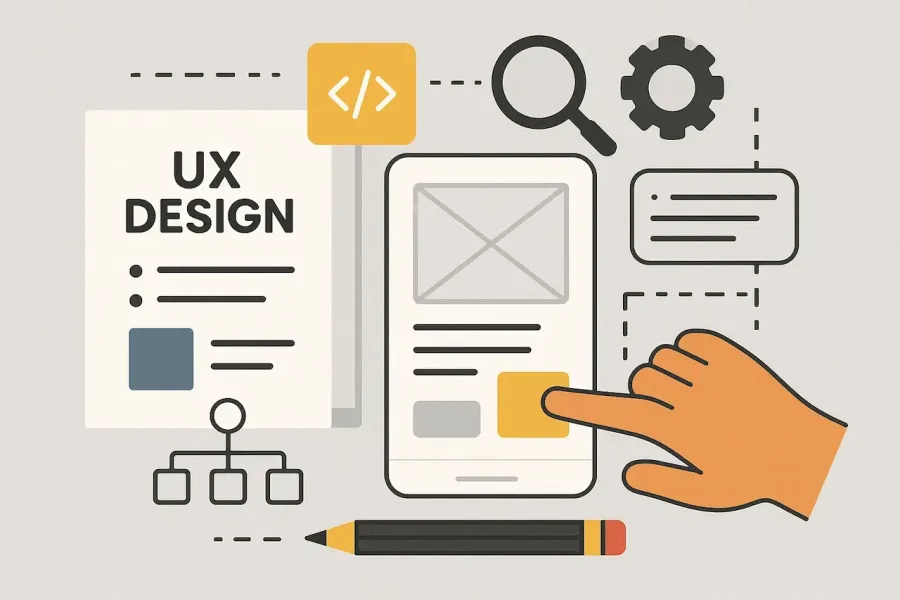
In the ever-evolving world of UX design, AI is transforming the landscape by reshaping every stage of the design process. AI in UX design isn’t just about achieving faster workflows or leveraging more data. It’s about making smarter design choices that resonate with users on a deeper level.
How AI is transforming UX Design? (image: Abwavestech)
As designers integrate intelligent tools into their daily work, they discover new opportunities and challenges in UX design that they might not have anticipated. Embracing AI in UX design allows professionals to craft more intuitive and engaging experiences, ultimately enhancing user satisfaction.
Enhancing user research with intelligent data analysis
By leveraging intelligent data analysis, you can quickly uncover patterns, trends, and pain points in user behavior.
AI sifts through feedback, session recordings, and survey results, highlighting what matters most.
This empowers you to make data-driven decisions, prioritize user needs, and design experiences that truly resonate with your audience.
Automating repetitive design tasks
After you’ve gathered valuable insights from user data, the next crucial step is integrating these findings into your design process.
AI technology plays a pivotal role here by automating repetitive design tasks, such as resizing assets, generating design variations, and creating responsive layouts.
By utilizing AI for these monotonous chores, you can concentrate on creative problem-solving and tackle higher-level design challenges. This not only speeds up production but also minimizes errors and ensures consistency across your user interfaces.
Embracing AI technology in your design tasks will transform how you approach app development, smartphone interfaces, and software designs, making your workflow more efficient and innovative.
Personalizing experiences through machine learning
Discover the power of machine learning in revolutionizing user experiences with your favorite apps and software.
By leveraging machine learning, technology can now offer real-time personalization, turning user data—like browsing habits, preferences, and behaviors—into tailored experiences.
This means that on your smartphone, you’ll see content, recommendations, and layouts that perfectly match your needs.
With machine learning, engagement skyrockets, satisfaction soars, and user retention improves, ensuring every interaction with technology is both meaningful and efficient.
Embrace the future of personalized experiences with machine learning today!
Improving accessibility for diverse audiences
Personalization powered by machine learning not only boosts engagement but also enhances accessibility for diverse audiences.
With AI technology, you can automatically tailor interfaces for users with visual, auditory, or motor impairments. AI-driven tools in apps and software identify accessibility gaps in real-time, offering features like alternative text, voice commands, or simplified layouts.
This ensures that everyone, regardless of ability, can interact with your digital products comfortably and effectively.
Streamlining prototyping and testing processes
In today’s fast-paced world of technology, AI is revolutionizing the way we approach prototyping and testing processes. AI-powered tools are now enabling you to rapidly build and iterate on prototypes, significantly reducing the time and effort traditionally required in UX design.
With these advanced tools, you can quickly generate interactive mockups, receive design improvement suggestions, and automate repetitive tasks. This allows you to identify usability issues early and gather actionable feedback much faster.
Predicting user needs with real-time insights
Harnessing AI-driven analytics has become a game-changer in the technology world, especially for apps, smartphones, and software.
By using AI tools, businesses can predict user needs with incredible accuracy as interactions happen in real time. These powerful AI tools analyze behavioral data, navigation patterns, and contextual cues instantly.
This allows companies to adapt interfaces and content proactively, ensuring users feel understood and supported. This level of responsiveness boosts user engagement and helps deliver seamless, intuitive experiences that align with evolving expectations.
Embracing AI-driven analytics is essential for staying ahead in the fast-paced world of technology, apps, and smartphones.
Empowering creative exploration and ideation
Integrating AI into the creative process unlocks new opportunities for exploration and ideation that were once beyond our grasp.
With AI-powered technology, you can swiftly produce a diverse array of design concepts, test various layouts, and refine ideas more rapidly than ever before.
These AI tools can suggest unexpected combinations and offer fresh insights, helping you escape creative blockades and expand the boundaries of UX innovation.
Addressing ethical considerations in AI-driven design
AI is revolutionizing the world of technology, apps, smartphones, and software, offering exciting possibilities in UX design. However, it’s crucial to address the ethical considerations that come with it.
When integrating AI into design, you must consider how algorithms handle user data, avoid bias, and ensure transparency in decision-making. Privacy concerns and the unintended consequences of automated personalization also play a significant role.
Conclusion
AI is transforming UX design in remarkable ways. With AI-powered technology, you can enhance user experiences by utilizing intelligent data analysis and automation. This allows for greater personalization and improved accessibility in your designs. By leveraging AI, designers can engage in rapid prototyping and gain real-time insights, enabling them to predict user needs and solve problems more efficiently than ever.
Embracing AI in UX design not only frees up time for creativity and innovation but also encourages designers to consider the ethical implications of technology. Ultimately, AI empowers you to craft more impactful, inclusive, and user-centered digital experiences, making UX design more effective and engaging.