Published on September 11, 2025 at 2:23 AMUpdated on September 11, 2025 at 2:23 AM
Artificial intelligence is rapidly reshaping the future of mobility, particularly in the field of autonomous vehicle safety. By combining advanced algorithms, real-time data interpretation, and predictive decision-making, AI allows self-driving cars to understand complex environments and react faster than any human driver could.
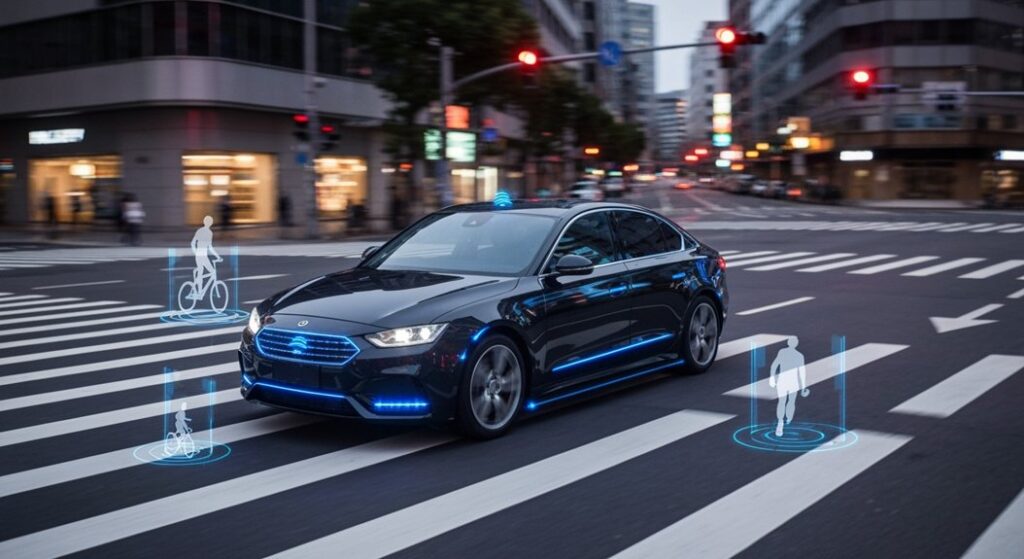
Discover how artificial intelligence improves autonomous vehicle safety (image Abwavestech)
These systems are designed to perceive the road, identify risks, and make instant adjustments that reduce the probability of collisions. As the technology advances, researchers continue to explore the limits of AI-driven safety, addressing ongoing challenges such as unpredictable human behavior, adverse weather conditions, and the need for reliable cybersecurity.
Understanding how AI enhances autonomous vehicle safety helps clarify why this technology is expected to transform transportation in the near future.
The Role of Machine Learning in Real-Time Decision Making
A critical foundation of autonomous vehicle safety is machine learning, which allows vehicles to analyze massive volumes of sensory data and act within fractions of a second. Machine learning models continuously evaluate input from cameras, lidar, radar, and other sensors to detect patterns that indicate potential hazards.
Through the use of predictive analytics, autonomous vehicles are able to anticipate dangerous situations rather than simply react to them. For example, when a pedestrian approaches a crosswalk or a bicycle swerves unexpectedly, machine learning models can interpret speed, angle, and motion patterns to predict possible outcomes. Because these models learn from millions of miles of previously recorded driving data, they become increasingly accurate over time.
This instantaneous processing of real-time information is essential for ensuring safe automated driving. By adjusting speed, changing lanes, or applying the brakes with precision, machine learning helps minimize risks even in fast-changing environments such as crowded highways or busy urban streets.
Sensor Fusion: Combining Data for Complete Environmental Awareness
Sensor fusion is another key AI technique responsible for dramatically improving autonomous vehicle safety. Instead of relying on a single type of sensor, autonomous vehicles combine data from cameras, radar, lidar, ultrasonic sensors, and even GPS. Each sensor has unique strengths—for instance, cameras capture color and detail, radar excels in detecting distance, and lidar maps surroundings in 3D.
When these inputs are merged through AI-driven algorithms, the vehicle gains a far more accurate and reliable understanding of its surroundings. Major benefits include:
Redundancy and error minimization: If one sensor fails or becomes obstructed, others compensate.
Enhanced perception: Multiple perspectives help eliminate blind spots.
Real-time synchronization: AI aligns all incoming data to produce a stable, unified view of the environment.
This comprehensive situational awareness is essential for navigating intersections, merging onto highways, and avoiding obstacles with precision.
Object Detection and Classification on the Road
Accurately identifying objects is one of the hardest tasks in autonomous driving, yet AI has made remarkable progress in this area. Using advanced image recognition and deep learning, autonomous vehicles can distinguish:
Other vehicles
Motorcycles and bicycles
Pedestrians
Animals
Road signs
Construction zones
Stationary objects like parked cars or barriers
Object classification allows the vehicle to assess risk and determine appropriate action—such as slowing down for a pedestrian or steering around a fallen branch. The system must be sensitive enough to detect small or partially obstructed objects, especially in low light or bad weather. AI-powered detection continues to improve as vehicles gather more real-world driving data.
Predicting Human Driver and Pedestrian Behavior
One of the most challenging factors in vehicle safety is human unpredictability. Human drivers may act impulsively, ignore signals, or behave erratically. Pedestrians may jaywalk, change direction suddenly, or become distracted by mobile devices.
AI addresses this issue through behavioral prediction models, which analyze body movements, gestures, speed, trajectory, and historical traffic interactions. Key functions include:
Predicting a pedestrian’s probable path
Anticipating lane changes from nearby vehicles
Recognizing signs of aggressive or impaired driving
Adjusting decisions based on subtle cues such as head orientation or hand signals
By accounting for human unpredictability, AI systems significantly reduce accident risk and create safer shared roadways.
Adaptive Cruise Control and Lane-Keeping Assistance
Core autonomous driving features like Adaptive Cruise Control (ACC) and Lane-Keeping Assistance (LKA) rely heavily on AI. These systems enhance safety by:
Maintaining optimal distance from the car ahead
Automatically adjusting speed based on traffic flow
Keeping the vehicle centered within lanes
Reducing the likelihood of rear-end collisions
Preventing unintentional lane drifting
AI continuously monitors road markings, nearby vehicles, and traffic patterns, providing smoother and safer driving experiences. These features also reduce driver fatigue, lowering the chances of human-error-related accidents.
Emergency Maneuvering and Collision Avoidance
In dangerous situations, AI-powered autonomous vehicles can execute emergency maneuvers faster and more accurately than human drivers. Using real-time risk assessment models, vehicles can:
Detect imminent collisions
Identify the safest escape path
Brake or swerve automatically
Avoid obstacles even at high speeds
These automated responses rely on rapid calculation and predictive modeling, ensuring that the vehicle takes the safest possible action in milliseconds.
Continuous Improvement Through Data Collection
Autonomous vehicles improve over time thanks to massive data collection. Every kilometer driven contributes to a broader dataset that enhances AI models. These continuous feedback loops allow systems to:
Learn from rare or complex scenarios
Improve response accuracy
Reduce false positives in object detection
Adapt to global driving conditions
This ongoing evolution is crucial for long-term safety reliability.
Overcoming Environmental Challenges with AI
Harsh environmental conditions present some of the greatest challenges for autonomous driving. AI helps mitigate these risks through:
Weather adaptation: Improved performance in fog, snow, rain, and low light
Terrain recognition: Detecting potholes, gravel, ice, or uneven surfaces
Dynamic obstacle detection: Rapid response to debris, animals, or sudden barriers
These capabilities help reduce accidents in situations where human visibility and reaction times are limited.
Cybersecurity Measures for Safer Autonomous Systems
Because autonomous vehicles are highly connected, strong cybersecurity is essential. AI enhances digital safety by enabling:
Secure network communication
Real-time threat detection
Data encryption
Access control
Vulnerability scanning
Incident response protocols
Protecting vehicle systems ensures safety not only from road hazards but also from digital threats that could compromise functionality.
Conclusion
Artificial intelligence plays an indispensable role in strengthening autonomous vehicle safety. From real-time decision-making and sensor fusion to advanced object detection, behavioral prediction, and emergency response, AI enables vehicles to navigate complex environments with remarkable precision. Continuous data learning and robust cybersecurity further enhance reliability and resilience. As AI systems evolve, autonomous vehicles will become even safer, reducing accidents and paving the way for a future where transportation is more efficient, predictable, and secure for all road users.