Published on September 10, 2025 at 2:23 PMUpdated on September 10, 2025 at 2:23 PM
Artificial intelligence is increasingly becoming integral to modern medical diagnostics, fundamentally changing how diseases are detected, monitored, and managed. By automating the analysis of medical data and interpreting highly complex images, AI systems assist clinicians in detecting diseases earlier and with greater precision than ever before. As healthcare environments become more demanding and patient data grows at an exponential rate, AI-driven tools support the management of vast clinical information, which simplifies workflows and reduces the cognitive burden on clinical teams. Still, as promising as these technologies are, artificial intelligence faces limitations and challenges that must be resolved before its full potential can be realized in routine clinical practice. Understanding how AI is currently used — and what obstacles remain — is essential for anyone interested in the direction of healthcare innovation.
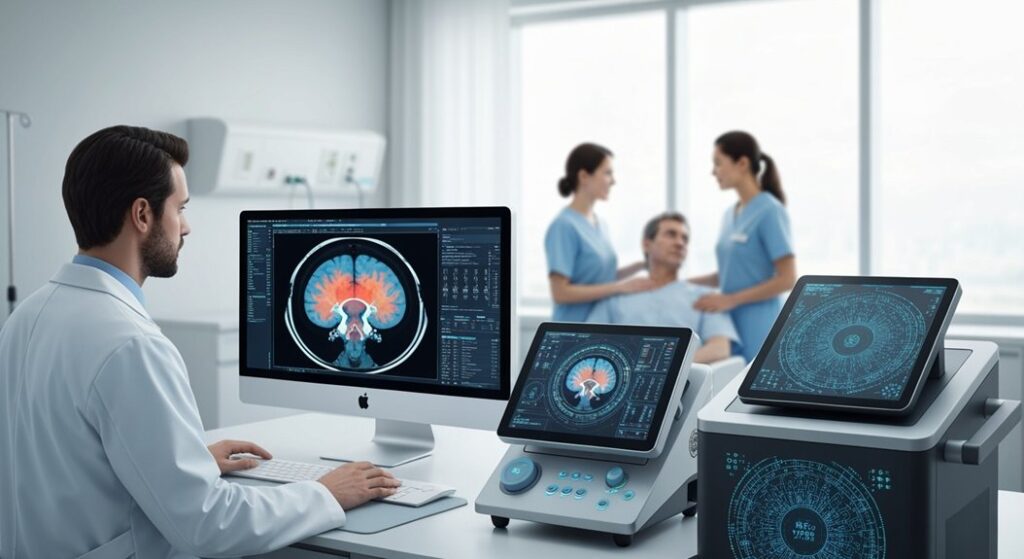
Discover how artificial intelligence is used in medical diagnostics (image: Abwavestech)
Medical imaging has long been central to diagnostic medicine, and advances in modalities such as MRI, CT scans, and ultrasound have significantly improved diagnostic accuracy. Artificial intelligence is now transforming this field even further by enabling automated analysis of complex visual data that traditionally required highly trained specialists.
AI-driven image segmentation techniques can delineate anatomical structures, tumors, lesions, and other abnormalities with remarkable precision. By reducing variability among radiologists and decreasing human error, these tools enhance diagnostic consistency. In addition, AI-powered pattern recognition systems can identify subtle changes in imaging that may go unnoticed in early disease stages, allowing for earlier interventions.
Another important contribution of AI is radiology workflow optimization. AI tools can automatically sort and prioritize urgent cases, helping radiologists focus on the most critical exams first. Automated pre-analysis, annotation, and report generation streamline reporting, while intelligent triage systems shorten turnaround times. The result is faster decision-making, reduced physician burnout, and more efficient utilization of clinical resources — all essential in modern, high-volume imaging departments.
Enhancing Pathology With Machine Learning
Beyond imaging, machine learning is revolutionizing the field of pathology. Traditionally, pathologists manually examine tissue samples under a microscope, looking for abnormalities in cell structure and tissue organization. This process, while powerful, is time-consuming and susceptible to human variability.
Machine learning algorithms now perform automated interpretation of tissue samples and cellular images, analyzing millions of pixels with speed and accuracy that exceed typical human capabilities. These algorithms can:
Detect subtle cellular abnormalities associated with early-stage cancer
Classify tissue types and disease subtypes
Quantify biomarkers and measure disease progression
Segment regions of interest with high precision
By streamlining workflows and reducing diagnostic discrepancies, AI in pathology helps ensure that clinicians receive reliable information quickly, enabling timely and effective treatment decisions.
AI-Powered Tools for Early Disease Detection
For decades, early disease detection has depended on routine screenings, patient-reported symptoms, and clinical intuition. Artificial intelligence disrupts this model by offering more proactive and predictive approaches to identifying illness.
AI systems use data-driven insights, predictive modeling, and symptom-assessment algorithms to improve the accuracy and efficiency of detection. These tools integrate data from medical imaging, lab results, sensors, wearables, and electronic health records (EHRs), giving clinicians a comprehensive view of patient health.
Key applications include:
Automated interpretation of medical imaging, flagging abnormalities that warrant further investigation.
Real-time analysis of electronic health records, identifying patterns that correlate with early disease markers.
Predictive modeling, which estimates a patient’s likelihood of developing conditions such as heart disease, diabetes, or cancer before symptoms appear.
By shifting healthcare toward prevention rather than reaction, AI tools help reduce morbidity, improve outcomes, and decrease the long-term cost of care.
Personalized Treatment Recommendations Using AI
Diagnosis is only the beginning of care. Artificial intelligence is also increasingly used to tailor treatment plans to individual patients. Using data such as genetics, lifestyle, environmental exposures, and previous response patterns, AI systems help clinicians choose therapies that are more likely to work for specific patients.
This personalized approach can:
Identify optimal medication combinations
Predict potential adverse drug reactions
Recommend dosage adjustments
Inform oncologists about the best treatment strategies based on tumor genetics
AI not only enhances treatment precision but also supports shared decision-making between clinicians and patients, helping individuals understand their options and likely outcomes.
Natural Language Processing in Clinical Data Analysis
A substantial portion of healthcare information exists in unstructured formats — physician notes, discharge summaries, consultation letters, and narrative reports. Natural Language Processing (NLP) makes it possible to extract meaningful insights from this wealth of textual data.
By applying text mining techniques to clinical narratives, NLP enables:
Identification of disease patterns hidden in physician notes
Extraction of relevant patient history from medical records
Summarization of complex clinical documentation
Automated coding and classification for administrative tasks
NLP enhances efficiency while also improving diagnostic safety by ensuring critical details are not overlooked during clinical decision-making.
Improving Diagnostic Accuracy With Deep Learning
Deep learning, a subset of machine learning, is especially powerful in medical diagnostics due to its ability to learn from vast amounts of data. By using data augmentation techniques, deep learning models can maintain performance levels even when datasets are limited — a common challenge in medical research.
These models have been applied to:
Skin lesion classification
Retinal disease detection
Heart rhythm analysis
Lung disease identification in chest radiographs
However, deep learning introduces interpretability challenges. Clinicians often want to understand the reasoning behind a model’s prediction, yet deep learning systems typically function as “black boxes.” To address this, researchers are developing explainable AI (XAI) systems that allow clinicians to see which features contributed to the diagnostic output.
Remote Diagnostics and Telemedicine Integration
As healthcare delivery increasingly shifts beyond hospitals and clinics, artificial intelligence plays a crucial role in enabling remote diagnostics and supporting telemedicine platforms.
AI enhances telemedicine by:
Analyzing patient data in real time during virtual consultations
Supporting remote monitoring of chronic diseases using connected devices
Alerting clinicians to significant changes in vital signs or symptoms
Integrating diagnostic results seamlessly into telemedicine workflows
This expansion of AI into remote care improves accessibility, especially for rural or underserved populations, and empowers patients to take a more active role in managing their health.
Challenges and Ethical Considerations in AI Diagnostics
As AI becomes more embedded in medical care, important ethical and practical questions arise. Key challenges include:
Bias mitigation: AI models can reproduce biases in training data, resulting in unequal diagnostic accuracy across populations.
Algorithm transparency: Clinicians need to understand how AI arrives at its conclusions.
Accountability: Determining responsibility when AI contributes to medical errors remains complex.
Safeguarding privacy, ensuring informed consent, and maintaining regulatory compliance are essential for building patient trust. Moreover, promoting equitable access to AI tools is crucial to prevent widening healthcare disparities.
Conclusion
Artificial intelligence is transforming medical diagnostics by enhancing accuracy, efficiency, and consistency across imaging, pathology, early disease detection, and clinical data analysis. Through advanced algorithms and deep learning techniques, AI supports personalized treatment, streamlines workflows, and improves patient outcomes.
Although challenges in ethics, transparency, and equitable access remain, the continued evolution of AI-driven diagnostic tools promises a future where healthcare is more precise, proactive, and patient-centered.